Metalworking Fluids Market Size by Product, Function, Application, End-Use and Region – Segment-Level Market Assessment, Growth Opportunity Analysis, Competitive Mapping & Forecast to 2032

4.8%
CAGR (2026-2032)
13.49 USD Bn.
Forecast Market Size
323
Report Pages
147
Market Tables

Overview

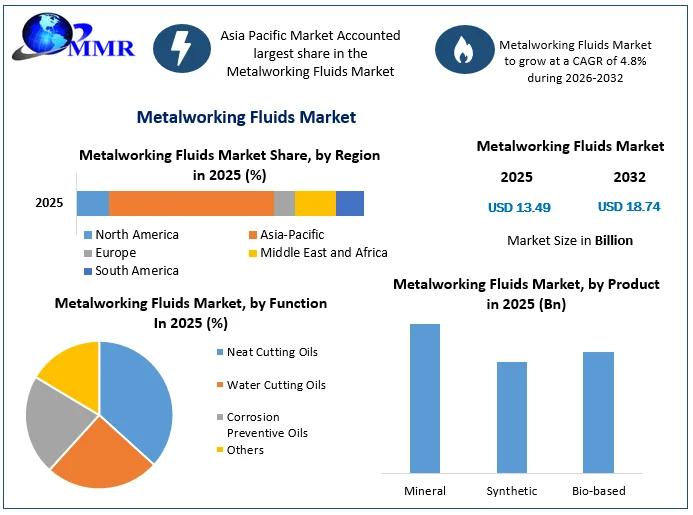
The Metalworking Fluids Market size was valued at USD 13.49 Billion in 2025 and the total Metalworking Fluids revenue is expected to grow at a CAGR of 4.8% from 2026 to 2032, reaching nearly USD 18.74 Billion.

Metalworking Fluids Market Overview:

The global Metalworking Fluids Market is expected to grow at a steady CAGR during the forecast period, driven by the increasing demand for precision machining, metal fabrication, and advanced manufacturing across the automotive, aerospace, machinery, construction, and industrial sectors. Metalworking fluids are widely used for cooling, lubrication, corrosion protection, and chip removal during machining, grinding, cutting, and forming operations, helping improve tool life, machining accuracy, and surface finish. The growing adoption of high-performance alloys, automated manufacturing processes, and computer numerical control (CNC) machining is further accelerating market growth.

The market is witnessing continuous innovation with the development of bio-based, low-VOC, and environmentally friendly metalworking fluids to comply with stringent environmental and occupational safety regulations. Manufacturers are investing in synthetic and semi-synthetic fluid formulations with enhanced cooling efficiency, extended service life, and improved microbial resistance to reduce maintenance costs and improve operational productivity. Furthermore, the expansion of electric vehicle (EV) manufacturing, aerospace production, precision engineering, and Industry 4.0-enabled smart manufacturing, coupled with increasing investments in sustainable industrial lubricants and advanced machining technologies, is expected to create significant long-term growth opportunities for the global Metalworking Fluids Market.

Metalworking Fluids Market size

To know about the Research Methodology :- Request Free Sample Report

Metalworking Fluids Market Dynamics:

Growing demand from automotive and precision manufacturing industries and increasing adoption of advanced machining technologies are driving market growth

The growing demand from the automotive and precision manufacturing industries and increasing adoption of advanced machining technologies are driving the growth of the global Metalworking Fluids Market. Metalworking fluids are widely used in cutting, grinding, milling, drilling, and forming operations to improve lubrication, reduce friction, dissipate heat, and enhance machining efficiency. The rapid expansion of automotive production, aerospace manufacturing, industrial machinery, and metal fabrication activities is significantly increasing the demand for high-performance metalworking fluids. Additionally, the growing adoption of computer numerical control (CNC) machining, automated manufacturing systems, and precision engineering is further supporting market expansion.

Stringent environmental regulations and rising raw material costs are restraining market growth

Stringent environmental regulations and rising raw material costs are restraining the growth of the global Metalworking Fluids Market. Manufacturers are facing increasing pressure to comply with stringent occupational safety and environmental regulations regarding the use, disposal, and recycling of conventional metalworking fluids. In addition, fluctuations in the prices of base oils, additives, and specialty chemicals, along with rising waste treatment and disposal costs, are impacting production costs and profit margins. Concerns related to worker exposure, fluid contamination, and microbial growth also require continuous investment in product innovation and fluid management solutions.

Growing adoption of bio-based metalworking fluids and increasing investments in electric vehicle manufacturing are creating market opportunities

The growing adoption of bio-based metalworking fluids and increasing investments in electric vehicle (EV) manufacturing are creating significant opportunities for the global Metalworking Fluids Market. Manufacturers are developing biodegradable, low-VOC, and environmentally friendly fluid formulations to meet evolving sustainability goals while delivering superior lubrication, cooling performance, and extended tool life. At the same time, the rapid expansion of EV production, aerospace components, medical devices, and high-precision industrial equipment is driving demand for advanced metalworking fluids capable of machining lightweight alloys and high-performance materials. Continuous innovations in synthetic and semi-synthetic fluid technologies, digital fluid monitoring systems, and smart manufacturing are expected to support long-term market growth.

Metalworking Fluids Market Trends

  • Growing adoption of bio-based and sustainable metalworking fluids is a key trend in the Metalworking Fluids Market - The growing adoption of bio-based and sustainable metalworking fluids is a key trend shaping the Metalworking Fluids Market. Manufacturers are increasingly developing biodegradable, low-VOC, and renewable-based fluid formulations to comply with stringent environmental regulations and improve workplace safety. Industries are replacing conventional mineral oil-based fluids with environmentally friendly alternatives that offer enhanced lubrication, reduced toxicity, and improved disposal characteristics. The growing emphasis on sustainability, circular manufacturing, and green industrial practices is further accelerating the adoption of bio-based metalworking fluids across automotive, aerospace, and general manufacturing applications.
  • Increasing integration of smart fluid management systems and high-performance synthetic formulations is transforming the Metalworking Fluids Market-The increasing integration of smart fluid management systems and high-performance synthetic formulations is transforming the Metalworking Fluids Market. Manufacturers are adopting IoT-enabled fluid monitoring, predictive maintenance, and automated coolant management technologies to optimize fluid performance, reduce downtime, and extend tool life. At the same time, the growing use of high-performance synthetic and semi-synthetic metalworking fluids is improving machining efficiency, thermal stability, corrosion protection, and compatibility with advanced materials such as titanium, aluminum alloys, and high-strength steels. Furthermore, rising investments in Industry 4.0, precision machining, electric vehicle manufacturing, and aerospace production are expected to support the long-term expansion of the global Metalworking Fluids Market.

Metalworking Fluids Market Segment Analysis:

Based on Product, the Mineral segment dominated the market with the largest share of about 52% of the Metalworking Fluid Market in 2025. The segment is further expected to maintain its dominance throughout the forecast period with the largest share in terms of both value and volume. The large share is attributed to the usage of mineral-based oils due to their low cost. Small and medium-sized producers often utilize mineral oil-based MWFs due to price-conscious consumers. This is expected to have an impact on the market's growth throughout the forecast period. Mineral-based fluids are also used in a wide range of machining operations, including turning, grinding, broaching, drilling, and milling. As a result, the demand from various end-users drives the segment growth.

The synthetic MWFs segment is expected to grow at a CAGR of about 4.1% over the forecast period. The qualities provided by MWFs, such as increased tool life and improved surface polish, are expected to drive segment growth. Because of their capacity to decrease friction between work components, eliminate waste, and lengthen sump life, synthetic oils are in great demand. Many nations' large-scale manufacturers have adopted semi-synthetic MWFs, resulting in an increase in synthetic MWF penetration during the past few years, which is expected to continue during the forecast period.

Based on Function, the Neat Cutting Oil segment held the largest share and dominated the Metalworking Fluids market in 2025. The segment is further expected to grow at a CAGR of 4.5% and maintain its dominance throughout the forecast period. The growth is attributable to increased demand from the automotive, aerospace, marine, and construction industries. They are used in a broad variety of machining procedures as well as cutting activities. They are in great demand from the high-volume manufacturing business in Asia Pacific's growing nations due to their ability to provide cost-effective solutions. Over the forecast period, the usage of high-alloy steels in the heavy equipment manufacturing industry is also expected to drive demand for the neat-cutting oils segment.

The water-cutting oil segment accounted for the second-largest market share in 2025. The growth is due to an increase in fluid utilization in several advanced machining procedures. Water Cutting Oil fluids are used in a wide range of operations where heat dissipation is essential for a successful machining process and high-quality products. They are diluted in water before being utilized in the machine shop for various cutting operations such as drilling, milling, and grinding. These fluids are utilized in heavy equipment manufacturing to keep the machining operation's temperature under control.

The semi-synthetic cutting oil segment in water-cutting oil is expected to grow at a significant CAGR during the forecast period. Its popularity can be attributed to its use in cast iron, aluminum components, and machining processes such as sawing, drilling, turning, and milling. The increased usage of these oils in various applications is expected to drive segment growth during the forecast period. Corrosion-preventative fluids are expected to increase at a consistent CAGR over the forecast period. These oils are used in machining operations where the danger of tool damage is high; as a result, these oils are responsible for increasing sump life, which results in decreased overhead costs for manufacturers. Small-scale firms have enhanced their use of corrosion-preventative oils due to their low production volumes and constrained cost structures.

Regional Analysis – Global Metalworking Fluids Market

Asia-Pacific Dominated the Global Metalworking Fluids Market

Asia-Pacific dominated the global Metalworking Fluids Market in 2025 and is expected to maintain its leading position throughout the forecast period. The region's dominance is driven by its strong manufacturing base, rapid industrialization, and the presence of major automotive, machinery, aerospace, and metal fabrication industries. Countries such as China, India, Japan, and South Korea are witnessing significant investments in precision engineering, electric vehicle (EV) manufacturing, industrial automation, and advanced machining technologies, driving the demand for high-performance metalworking fluids. Additionally, expanding infrastructure development, favorable government initiatives supporting manufacturing, and increasing adoption of CNC machining and Industry 4.0 technologies are further strengthening regional market growth.

North America Holds a Significant Share of the Metalworking Fluids Market

North America accounted for a substantial share of the global Metalworking Fluids Market, driven by the strong presence of aerospace, automotive, industrial machinery, medical device, and defense manufacturing industries. The United States and Canada are increasingly adopting advanced machining technologies, smart manufacturing systems, and high-performance synthetic metalworking fluids to improve production efficiency and product quality. Growing investments in reshoring manufacturing operations, electric vehicle production, and precision engineering, along with increasing demand for sustainable and bio-based metalworking fluids, are supporting continued market expansion across the region.

Europe is Expected to Register Strong Growth in the Metalworking Fluids Market

Europe is expected to witness strong growth during the forecast period, supported by its well-established automotive, aerospace, and industrial equipment sectors. Countries including Germany, France, Italy, the United Kingdom, and Sweden are investing in advanced manufacturing technologies, lightweight material processing, and sustainable industrial lubricants to improve machining efficiency and reduce environmental impact. Stringent environmental regulations, increasing adoption of biodegradable metalworking fluids, and growing investments in Industry 4.0 and precision manufacturing are expected to drive the market across the region.

Latin America and the Middle East & Africa are Emerging Markets

Latin America and the Middle East & Africa are expected to experience steady growth in the Metalworking Fluids Market during the forecast period. Countries such as Brazil, Mexico, Saudi Arabia, the UAE, and South Africa are witnessing increasing investments in automotive assembly, metal processing, oil & gas equipment manufacturing, and industrial infrastructure. Rising industrialization, expanding manufacturing activities, and growing adoption of advanced machining processes are creating new opportunities for metalworking fluid manufacturers. Furthermore, increasing awareness of sustainable manufacturing practices and the modernization of production facilities are expected to support long-term market growth across these regions.

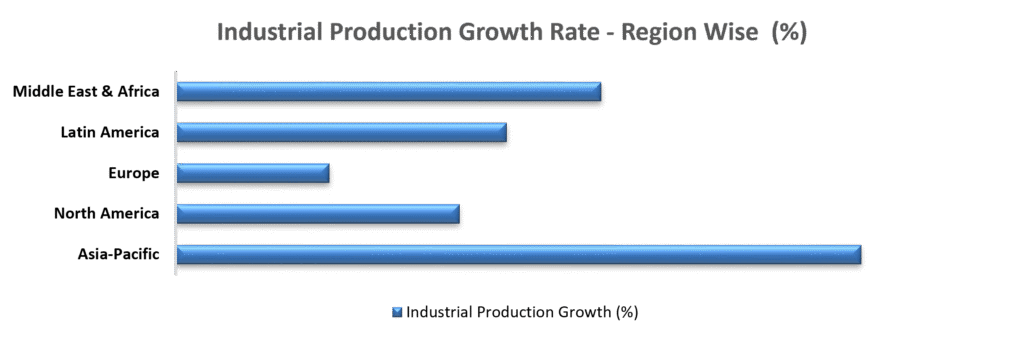
Global Industrial Production - Region Wise (2025)

Asia-Pacific recorded the highest industrial production growth in 2025, supported by expanding manufacturing activities in China, India, Vietnam, and Southeast Asia, along with strong investments in automotive, electronics, machinery, and metal fabrication industries. North America maintained moderate growth, driven by industrial automation, aerospace, and reshoring initiatives, while Europe experienced slower expansion due to weaker manufacturing output and energy-related cost pressures. Latin America and the Middle East & Africa registered steady growth, supported by infrastructure development, mining, oil & gas, and industrial diversification initiatives.

Metalworking Fluids Market Recent Developments:

Month & Year Recent Development Strategic Impact
May 2026 Quaker Houghton introduced next-generation metalworking fluids designed for electric vehicle component manufacturing, offering enhanced cooling performance and extended tool life. Strengthened the company's product portfolio for EV manufacturing and advanced machining applications.
March 2026 FUCHS SE expanded its portfolio of biodegradable and bio-based metalworking fluids to support sustainable manufacturing and comply with evolving environmental regulations. Enhanced its sustainable lubricant offerings and strengthened its position in environmentally friendly industrial solutions.
January 2026 Blaser Swisslube AG launched advanced high-performance cutting fluids optimized for precision machining of aerospace alloys and medical-grade materials. Expanded its specialty product portfolio and improved competitiveness in high-value manufacturing sectors.
October 2025 Castrol Limited introduced advanced synthetic metalworking fluid formulations with improved oxidation stability and enhanced machining efficiency for industrial manufacturing. Improved machining performance, extended fluid life, and strengthened its industrial lubricants portfolio.
August 2025 Master Fluid Solutions expanded its global manufacturing and technical service capabilities to meet the increasing demand for customized metalworking fluid solutions across automotive and aerospace industries. Increased production capacity, enhanced customer support, and strengthened its global market presence.

Competitive Landscape – Global Metalworking Fluids Market

The global Metalworking Fluids Market is highly competitive, with leading manufacturers focusing on product innovation, sustainable formulations, strategic acquisitions, and geographic expansion to strengthen their market positions. Companies are investing in high-performance synthetic and semi-synthetic metalworking fluids, bio-based lubricants, and advanced fluid management technologies to improve machining efficiency, extend tool life, and comply with increasingly stringent environmental regulations. Manufacturers are also expanding production capacities, strengthening distribution networks, and collaborating with automotive, aerospace, and industrial equipment manufacturers to address the growing demand for precision machining and sustainable manufacturing solutions.

Major industry participants such as Quaker Houghton, FUCHS SE, Castrol Limited, Exxon Mobil Corporation, Chevron Corporation, TotalEnergies SE, BP plc, PETRONAS Lubricants International, Blaser Swisslube AG, and Master Fluid Solutions are strengthening their competitive positions through continuous R&D investments, digital fluid monitoring technologies, sustainable product development, and customized metalworking fluid solutions. Their strategic focus on bio-based formulations, Industry 4.0-compatible fluid management systems, and high-performance machining solutions is enabling them to capitalize on growing demand across automotive, aerospace, general manufacturing, and precision engineering industries.

Metalworking Fluids Market Scope: Inquire before buying

Metalworking Fluids Market
Report Coverage Details
Base Year: 2025 Forecast Period: 2026-2032
Historical Data: 2020 to 2025 Market Size in 2025: USD 13.49 Bn.
Forecast Period 2026 to 2032 CAGR: 4.8% Market Size in 2032: USD 18.74 Bn.
Segments Covered: by Product Mineral
Synthetic
Bio-based
by Function Neat Cutting Oils
Water Cutting Oils
Corrosion Preventive Oils
Others
by Application Construction
Electric & Power
Agriculture
Automobile
Aerospace
Rail
Marine
Telecommunication
Healthcare
by End-Use Metal Fabrication
Transportation Equipment
Machinery
Others

Metalworking Fluids Market, by Region

North America (United States, Canada and Mexico)
Europe (UK, France, Germany, Italy, Spain, Sweden, Austria, Turkey, Russia and Rest of Europe)
Asia Pacific (China, India, Japan, South Korea, Australia, ASEAN and Rest of APAC)
Middle East and Africa (South Africa, GCC, Egypt, Nigeria and Rest of ME&A)
South America (Brazil, Argentina, Columbia and Rest of South America)

Metalworking Fluids Market Key Players are:

1. ExxonMobil Corporation (U.S.)
2. Houghton International Inc. (U.S.)
3. Chevron Corporation (U.S.)
4. Lubrizol Corporation (U.S.)
5. Quaker Chemical Corporation (U.S.)
6. The Dow Chemical Company (U.S.)
7. Master Chemical Corporation (U.S.)
8. Cimcool Industrial Products LLC (U.S.)
9. Lukoil Oil Company (Russia)
10.Blaser Swisslube AG (Switzerland)
11.Clariant AG (Switzerland)
12.Infineum International Limited (U.K.)
13.Croda International Plc. (U.K)
14.Shell (Netherlands)
15.Lukoil Lubricants ( Russia)
16.Fuchs Petrolub SE (Germany)
17.Total S.A. (France)
18.China Petroleum & Chemical Corp. (China)
19.Idemitsu Kosan Co. Ltd (Japan)
20.BP plc. (India)
21.Milacron, Henkel Corporation (India)
22.Apar Industries Ltd. (India)
23.Yushiro Chemical Industry Co. Ltd. (Japan)
24.Metalworking Lubricants Company (India)
25.Indian Oil Corporation Ltd (India)

FAQs:

1. What are the growth drivers for the Metalworking Fluids market?
Ans. The increasing automotive sector, increasing commercialization, growing building activity, rapidly changing customer preferences for customized automobiles, as well as increased demand for lightweight and fuel-efficient vehicles are expected to be the major driver for the Metalworking Fluids market.

2. What is the major restraint for the Metalworking Fluids market growth?
Ans. The Stringent Regulations on the Metalworking Fluids adoption are expected to be the major restraining factor for the Metalworking Fluids market growth.

3. Which region is expected to lead the global Metalworking Fluids market during the forecast period?
Ans. The Asia-Pacific market is expected to lead the global Metalworking Fluids market during the forecast period due to the increased number of production plants in the Asia-Pacific region increasing the demand for Metalworking Fluids products and eventually driving the market growth.

4. What was the Metalworking Fluids Market size in 2025?
Ans:
The Metalworking Fluids Market size was USD 13.49 Billion in 2025.

5. What segments are covered in the Market report?
Ans. The segments covered are Product, Function, Application, End-use, and Region.

Table of Contents

1. Metalworking Fluids Market Introduction 1.1. Study Assumption and Market Definition 1.2. Scope of the Study 1.3. Executive Summary 2. Global Metalworking Fluids Market: Competitive Landscape 2.1. MMR Competition Matrix 2.2. Competitive Landscape 2.3. Key Players Benchmarking 2.3.1. Company Name 2.3.2. Business Segment 2.3.3. End-user Segment 2.3.4. Revenue (2025) 2.3.5. Company Locations 2.4. Leading Metalworking Fluids Market Companies, by market capitalization 2.5. Market Structure 2.5.1. Market Leaders 2.5.2. Market Followers 2.5.3. Emerging Players 2.6. Mergers and Acquisitions Details 3. Metalworking Fluids Market: Dynamics 3.1. Metalworking Fluids Market Trends by Region 3.1.1. North America Metalworking Fluids Market Trends 3.1.2. Europe Metalworking Fluids Market Trends 3.1.3. Asia Pacific Metalworking Fluids Market Trends 3.1.4. Middle East and Africa Metalworking Fluids Market Trends 3.1.5. South America Metalworking Fluids Market Trends 3.2. Metalworking Fluids Market Dynamics by Region 3.2.1. North America 3.2.1.1. North America Metalworking Fluids Market Drivers 3.2.1.2. North America Metalworking Fluids Market Restraints 3.2.1.3. North America Metalworking Fluids Market Opportunities 3.2.1.4. North America Metalworking Fluids Market Challenges 3.2.2. Europe 3.2.2.1. Europe Metalworking Fluids Market Drivers 3.2.2.2. Europe Metalworking Fluids Market Restraints 3.2.2.3. Europe Metalworking Fluids Market Opportunities 3.2.2.4. Europe Metalworking Fluids Market Challenges 3.2.3. Asia Pacific 3.2.3.1. Asia Pacific Metalworking Fluids Market Drivers 3.2.3.2. Asia Pacific Metalworking Fluids Market Restraints 3.2.3.3. Asia Pacific Metalworking Fluids Market Opportunities 3.2.3.4. Asia Pacific Metalworking Fluids Market Challenges 3.2.4. Middle East and Africa 3.2.4.1. Middle East and Africa Metalworking Fluids Market Drivers 3.2.4.2. Middle East and Africa Metalworking Fluids Market Restraints 3.2.4.3. Middle East and Africa Metalworking Fluids Market Opportunities 3.2.4.4. Middle East and Africa Metalworking Fluids Market Challenges 3.2.5. South America 3.2.5.1. South America Metalworking Fluids Market Drivers 3.2.5.2. South America Metalworking Fluids Market Restraints 3.2.5.3. South America Metalworking Fluids Market Opportunities 3.2.5.4. South America Metalworking Fluids Market Challenges 3.3. PORTER's Five Forces Analysis 3.4. PESTLE Analysis 3.5. Technology Roadmap 3.6. Regulatory Landscape by Region 3.6.1. North America 3.6.2. Europe 3.6.3. Asia Pacific 3.6.4. Middle East and Africa 3.6.5. South America 3.7. Key Opinion Leader Analysis For Metalworking Fluids Industry 3.8. Analysis of Government Schemes and Initiatives For Metalworking Fluids Industry 3.9. Metalworking Fluids Market Trade Analysis 3.10. The Global Pandemic Impact on Metalworking Fluids Market 4. Metalworking Fluids Market: Global Market Size and Forecast by Segmentation (in USD Billion) 2025-2032 4.1. Metalworking Fluids Market Size and Forecast, by Product (2025-2032) 4.1.1. Mineral 4.1.2. Synthetic 4.1.3. Bio-based 4.2. Metalworking Fluids Market Size and Forecast, by Function (2025-2032) 4.2.1. Neat Cutting Oils 4.2.2. Water Cutting Oils 4.2.3. Corrosion Preventive Oils 4.2.4. Others 4.3. Metalworking Fluids Market Size and Forecast, by Application (2025-2032) 4.3.1. Construction 4.3.2. Electric & Power 4.3.3. Agriculture 4.3.4. Automobile 4.3.5. Aerospace 4.3.6. Rail 4.3.7. Marine 4.3.8. Telecommunication 4.3.9. Healthcare 4.4. Metalworking Fluids Market Size and Forecast, by End-Use (2025-2032) 4.4.1. Metal Fabrication 4.4.2. Transportation Equipment 4.4.3. Machinery 4.4.4. Others 4.5. Metalworking Fluids Market Size and Forecast, by Region (2025-2032) 4.5.1. North America 4.5.2. Europe 4.5.3. Asia Pacific 4.5.4. Middle East and Africa 4.5.5. South America 5. North America Metalworking Fluids Market Size and Forecast by Segmentation (in USD Billion) 2025-2032 5.1. North America Metalworking Fluids Market Size and Forecast, by Product (2025-2032) 5.1.1. Mineral 5.1.2. Synthetic 5.1.3. Bio-based 5.2. North America Metalworking Fluids Market Size and Forecast, by Function (2025-2032) 5.2.1. Neat Cutting Oils 5.2.2. Water Cutting Oils 5.2.3. Corrosion Preventive Oils 5.2.4. Others 5.3. North America Metalworking Fluids Market Size and Forecast, by Application (2025-2032) 5.3.1. Construction 5.3.2. Electric & Power 5.3.3. Agriculture 5.3.4. Automobile 5.3.5. Aerospace 5.3.6. Rail 5.3.7. Marine 5.3.8. Telecommunication 5.3.9. Healthcare 5.4. North America Metalworking Fluids Market Size and Forecast, by End-Use (2025-2032) 5.4.1. Metal Fabrication 5.4.2. Transportation Equipment 5.4.3. Machinery 5.4.4. Others 5.5. North America Metalworking Fluids Market Size and Forecast, by Country (2025-2032) 5.5.1. United States 5.5.1.1. United States Metalworking Fluids Market Size and Forecast, by Product (2025-2032) 5.5.1.1.1. Mineral 5.5.1.1.2. Synthetic 5.5.1.1.3. Bio-based 5.5.1.2. United States Metalworking Fluids Market Size and Forecast, by Function (2025-2032) 5.5.1.2.1. Neat Cutting Oils 5.5.1.2.2. Water Cutting Oils 5.5.1.2.3. Corrosion Preventive Oils 5.5.1.2.4. Others 5.5.1.3. United States Metalworking Fluids Market Size and Forecast, by Application (2025-2032) 5.5.1.3.1. Construction 5.5.1.3.2. Electric & Power 5.5.1.3.3. Agriculture 5.5.1.3.4. Automobile 5.5.1.3.5. Aerospace 5.5.1.3.6. Rail 5.5.1.3.7. Marine 5.5.1.3.8. Telecommunication 5.5.1.3.9. Healthcare 5.5.1.4. United States Metalworking Fluids Market Size and Forecast, by End-Use (2025-2032) 5.5.1.4.1. Metal Fabrication 5.5.1.4.2. Transportation Equipment 5.5.1.4.3. Machinery 5.5.1.4.4. Others 5.5.2. Canada 5.5.2.1. Canada Metalworking Fluids Market Size and Forecast, by Product (2025-2032) 5.5.2.1.1. Mineral 5.5.2.1.2. Synthetic 5.5.2.1.3. Bio-based 5.5.2.2. Canada Metalworking Fluids Market Size and Forecast, by Function (2025-2032) 5.5.2.2.1. Neat Cutting Oils 5.5.2.2.2. Water Cutting Oils 5.5.2.2.3. Corrosion Preventive Oils 5.5.2.2.4. Others 5.5.2.3. Canada Metalworking Fluids Market Size and Forecast, by Application (2025-2032) 5.5.2.3.1. Construction 5.5.2.3.2. Electric & Power 5.5.2.3.3. Agriculture 5.5.2.3.4. Automobile 5.5.2.3.5. Aerospace 5.5.2.3.6. Rail 5.5.2.3.7. Marine 5.5.2.3.8. Telecommunication 5.5.2.3.9. Healthcare 5.5.2.4. Canada Metalworking Fluids Market Size and Forecast, by End-Use (2025-2032) 5.5.2.4.1. Metal Fabrication 5.5.2.4.2. Transportation Equipment 5.5.2.4.3. Machinery 5.5.2.4.4. Others 5.5.3. Mexico 5.5.3.1. Mexico Metalworking Fluids Market Size and Forecast, by Product (2025-2032) 5.5.3.1.1. Mineral 5.5.3.1.2. Synthetic 5.5.3.1.3. Bio-based 5.5.3.2. Mexico Metalworking Fluids Market Size and Forecast, by Function (2025-2032) 5.5.3.2.1. Neat Cutting Oils 5.5.3.2.2. Water Cutting Oils 5.5.3.2.3. Corrosion Preventive Oils 5.5.3.2.4. Others 5.5.3.3. Mexico Metalworking Fluids Market Size and Forecast, by Application (2025-2032) 5.5.3.3.1. Construction 5.5.3.3.2. Electric & Power 5.5.3.3.3. Agriculture 5.5.3.3.4. Automobile 5.5.3.3.5. Aerospace 5.5.3.3.6. Rail 5.5.3.3.7. Marine 5.5.3.3.8. Telecommunication 5.5.3.3.9. Healthcare 5.5.3.4. Mexico Metalworking Fluids Market Size and Forecast, by End-Use (2025-2032) 5.5.3.4.1. Metal Fabrication 5.5.3.4.2. Transportation Equipment 5.5.3.4.3. Machinery 5.5.3.4.4. Others 6. Europe Metalworking Fluids Market Size and Forecast by Segmentation (in USD Billion) 2025-2032 6.1. Europe Metalworking Fluids Market Size and Forecast, by Product (2025-2032) 6.2. Europe Metalworking Fluids Market Size and Forecast, by Function (2025-2032) 6.3. Europe Metalworking Fluids Market Size and Forecast, by Application (2025-2032) 6.4. Europe Metalworking Fluids Market Size and Forecast, by End-Use (2025-2032) 6.5. Europe Metalworking Fluids Market Size and Forecast, by Country (2025-2032) 6.5.1. United Kingdom 6.5.1.1. United Kingdom Metalworking Fluids Market Size and Forecast, by Product (2025-2032) 6.5.1.2. United Kingdom Metalworking Fluids Market Size and Forecast, by Function (2025-2032) 6.5.1.3. United Kingdom Metalworking Fluids Market Size and Forecast, by Application (2025-2032) 6.5.1.4. United Kingdom Metalworking Fluids Market Size and Forecast, by End-Use (2025-2032) 6.5.2. France 6.5.2.1. France Metalworking Fluids Market Size and Forecast, by Product (2025-2032) 6.5.2.2. France Metalworking Fluids Market Size and Forecast, by Function (2025-2032) 6.5.2.3. France Metalworking Fluids Market Size and Forecast, by Application (2025-2032) 6.5.2.4. France Metalworking Fluids Market Size and Forecast, by End-Use (2025-2032) 6.5.3. Germany 6.5.3.1. Germany Metalworking Fluids Market Size and Forecast, by Product (2025-2032) 6.5.3.2. Germany Metalworking Fluids Market Size and Forecast, by Function (2025-2032) 6.5.3.3. Germany Metalworking Fluids Market Size and Forecast, by Application (2025-2032) 6.5.3.4. Germany Metalworking Fluids Market Size and Forecast, by End-Use (2025-2032) 6.5.4. Italy 6.5.4.1. Italy Metalworking Fluids Market Size and Forecast, by Product (2025-2032) 6.5.4.2. Italy Metalworking Fluids Market Size and Forecast, by Function (2025-2032) 6.5.4.3. Italy Metalworking Fluids Market Size and Forecast, by Application (2025-2032) 6.5.4.4. Italy Metalworking Fluids Market Size and Forecast, by End-Use (2025-2032) 6.5.5. Spain 6.5.5.1. Spain Metalworking Fluids Market Size and Forecast, by Product (2025-2032) 6.5.5.2. Spain Metalworking Fluids Market Size and Forecast, by Function (2025-2032) 6.5.5.3. Spain Metalworking Fluids Market Size and Forecast, by Application (2025-2032) 6.5.5.4. Spain Metalworking Fluids Market Size and Forecast, by End-Use (2025-2032) 6.5.6. Sweden 6.5.6.1. Sweden Metalworking Fluids Market Size and Forecast, by Product (2025-2032) 6.5.6.2. Sweden Metalworking Fluids Market Size and Forecast, by Function (2025-2032) 6.5.6.3. Sweden Metalworking Fluids Market Size and Forecast, by Application (2025-2032) 6.5.6.4. Sweden Metalworking Fluids Market Size and Forecast, by End-Use (2025-2032) 6.5.7. Austria 6.5.7.1. Austria Metalworking Fluids Market Size and Forecast, by Product (2025-2032) 6.5.7.2. Austria Metalworking Fluids Market Size and Forecast, by Function (2025-2032) 6.5.7.3. Austria Metalworking Fluids Market Size and Forecast, by Application (2025-2032) 6.5.7.4. Austria Metalworking Fluids Market Size and Forecast, by End-Use (2025-2032) 6.5.8. Rest of Europe 6.5.8.1. Rest of Europe Metalworking Fluids Market Size and Forecast, by Product (2025-2032) 6.5.8.2. Rest of Europe Metalworking Fluids Market Size and Forecast, by Function (2025-2032) 6.5.8.3. Rest of Europe Metalworking Fluids Market Size and Forecast, by Application (2025-2032) 6.5.8.4. Rest of Europe Metalworking Fluids Market Size and Forecast, by End-Use (2025-2032) 7. Asia Pacific Metalworking Fluids Market Size and Forecast by Segmentation (in USD Billion) 2025-2032 7.1. Asia Pacific Metalworking Fluids Market Size and Forecast, by Product (2025-2032) 7.2. Asia Pacific Metalworking Fluids Market Size and Forecast, by Function (2025-2032) 7.3. Asia Pacific Metalworking Fluids Market Size and Forecast, by Application (2025-2032) 7.4. Asia Pacific Metalworking Fluids Market Size and Forecast, by End-Use (2025-2032) 7.5. Asia Pacific Metalworking Fluids Market Size and Forecast, by Country (2025-2032) 7.5.1. China 7.5.1.1. China Metalworking Fluids Market Size and Forecast, by Product (2025-2032) 7.5.1.2. China Metalworking Fluids Market Size and Forecast, by Function (2025-2032) 7.5.1.3. China Metalworking Fluids Market Size and Forecast, by Application (2025-2032) 7.5.1.4. China Metalworking Fluids Market Size and Forecast, by End-Use (2025-2032) 7.5.2. S Korea 7.5.2.1. S Korea Metalworking Fluids Market Size and Forecast, by Product (2025-2032) 7.5.2.2. S Korea Metalworking Fluids Market Size and Forecast, by Function (2025-2032) 7.5.2.3. S Korea Metalworking Fluids Market Size and Forecast, by Application (2025-2032) 7.5.2.4. S Korea Metalworking Fluids Market Size and Forecast, by End-Use (2025-2032) 7.5.3. Japan 7.5.3.1. Japan Metalworking Fluids Market Size and Forecast, by Product (2025-2032) 7.5.3.2. Japan Metalworking Fluids Market Size and Forecast, by Function (2025-2032) 7.5.3.3. Japan Metalworking Fluids Market Size and Forecast, by Application (2025-2032) 7.5.3.4. Japan Metalworking Fluids Market Size and Forecast, by End-Use (2025-2032) 7.5.4. India 7.5.4.1. India Metalworking Fluids Market Size and Forecast, by Product (2025-2032) 7.5.4.2. India Metalworking Fluids Market Size and Forecast, by Function (2025-2032) 7.5.4.3. India Metalworking Fluids Market Size and Forecast, by Application (2025-2032) 7.5.4.4. India Metalworking Fluids Market Size and Forecast, by End-Use (2025-2032) 7.5.5. Australia 7.5.5.1. Australia Metalworking Fluids Market Size and Forecast, by Product (2025-2032) 7.5.5.2. Australia Metalworking Fluids Market Size and Forecast, by Function (2025-2032) 7.5.5.3. Australia Metalworking Fluids Market Size and Forecast, by Application (2025-2032) 7.5.5.4. Australia Metalworking Fluids Market Size and Forecast, by End-Use (2025-2032) 7.5.6. Indonesia 7.5.6.1. Indonesia Metalworking Fluids Market Size and Forecast, by Product (2025-2032) 7.5.6.2. Indonesia Metalworking Fluids Market Size and Forecast, by Function (2025-2032) 7.5.6.3. Indonesia Metalworking Fluids Market Size and Forecast, by Application (2025-2032) 7.5.6.4. Indonesia Metalworking Fluids Market Size and Forecast, by End-Use (2025-2032) 7.5.7. Malaysia 7.5.7.1. Malaysia Metalworking Fluids Market Size and Forecast, by Product (2025-2032) 7.5.7.2. Malaysia Metalworking Fluids Market Size and Forecast, by Function (2025-2032) 7.5.7.3. Malaysia Metalworking Fluids Market Size and Forecast, by Application (2025-2032) 7.5.7.4. Malaysia Metalworking Fluids Market Size and Forecast, by End-Use (2025-2032) 7.5.8. Vietnam 7.5.8.1. Vietnam Metalworking Fluids Market Size and Forecast, by Product (2025-2032) 7.5.8.2. Vietnam Metalworking Fluids Market Size and Forecast, by Function (2025-2032) 7.5.8.3. Vietnam Metalworking Fluids Market Size and Forecast, by Application (2025-2032) 7.5.8.4. Vietnam Metalworking Fluids Market Size and Forecast, by End-Use (2025-2032) 7.5.9. Taiwan 7.5.9.1. Taiwan Metalworking Fluids Market Size and Forecast, by Product (2025-2032) 7.5.9.2. Taiwan Metalworking Fluids Market Size and Forecast, by Function (2025-2032) 7.5.9.3. Taiwan Metalworking Fluids Market Size and Forecast, by Application (2025-2032) 7.5.9.4. Taiwan Metalworking Fluids Market Size and Forecast, by End-Use (2025-2032) 7.5.10. Rest of Asia Pacific 7.5.10.1. Rest of Asia Pacific Metalworking Fluids Market Size and Forecast, by Product (2025-2032) 7.5.10.2. Rest of Asia Pacific Metalworking Fluids Market Size and Forecast, by Function (2025-2032) 7.5.10.3. Rest of Asia Pacific Metalworking Fluids Market Size and Forecast, by Application (2025-2032) 7.5.10.4. Rest of Asia Pacific Metalworking Fluids Market Size and Forecast, by End-Use (2025-2032) 8. Middle East and Africa Metalworking Fluids Market Size and Forecast by Segmentation (in USD Billion) 2025-2032 8.1. Middle East and Africa Metalworking Fluids Market Size and Forecast, by Product (2025-2032) 8.2. Middle East and Africa Metalworking Fluids Market Size and Forecast, by Function (2025-2032) 8.3. Middle East and Africa Metalworking Fluids Market Size and Forecast, by Application (2025-2032) 8.4. Middle East and Africa Metalworking Fluids Market Size and Forecast, by End-Use (2025-2032) 8.5. Middle East and Africa Metalworking Fluids Market Size and Forecast, by Country (2025-2032) 8.5.1. South Africa 8.5.1.1. South Africa Metalworking Fluids Market Size and Forecast, by Product (2025-2032) 8.5.1.2. South Africa Metalworking Fluids Market Size and Forecast, by Function (2025-2032) 8.5.1.3. South Africa Metalworking Fluids Market Size and Forecast, by Application (2025-2032) 8.5.1.4. South Africa Metalworking Fluids Market Size and Forecast, by End-Use (2025-2032) 8.5.2. GCC 8.5.2.1. GCC Metalworking Fluids Market Size and Forecast, by Product (2025-2032) 8.5.2.2. GCC Metalworking Fluids Market Size and Forecast, by Function (2025-2032) 8.5.2.3. GCC Metalworking Fluids Market Size and Forecast, by Application (2025-2032) 8.5.2.4. GCC Metalworking Fluids Market Size and Forecast, by End-Use (2025-2032) 8.5.3. Nigeria 8.5.3.1. Nigeria Metalworking Fluids Market Size and Forecast, by Product (2025-2032) 8.5.3.2. Nigeria Metalworking Fluids Market Size and Forecast, by Function (2025-2032) 8.5.3.3. Nigeria Metalworking Fluids Market Size and Forecast, by Application (2025-2032) 8.5.3.4. Nigeria Metalworking Fluids Market Size and Forecast, by End-Use (2025-2032) 8.5.4. Rest of ME&A 8.5.4.1. Rest of ME&A Metalworking Fluids Market Size and Forecast, by Product (2025-2032) 8.5.4.2. Rest of ME&A Metalworking Fluids Market Size and Forecast, by Function (2025-2032) 8.5.4.3. Rest of ME&A Metalworking Fluids Market Size and Forecast, by Application (2025-2032) 8.5.4.4. Rest of ME&A Metalworking Fluids Market Size and Forecast, by End-Use (2025-2032) 9. South America Metalworking Fluids Market Size and Forecast by Segmentation (in USD Billion) 2025-2032 9.1. South America Metalworking Fluids Market Size and Forecast, by Product (2025-2032) 9.2. South America Metalworking Fluids Market Size and Forecast, by Function (2025-2032) 9.3. South America Metalworking Fluids Market Size and Forecast, by Application (2025-2032) 9.4. South America Metalworking Fluids Market Size and Forecast, by End-Use (2025-2032) 9.5. South America Metalworking Fluids Market Size and Forecast, by Country (2025-2032) 9.5.1. Brazil 9.5.1.1. Brazil Metalworking Fluids Market Size and Forecast, by Product (2025-2032) 9.5.1.2. Brazil Metalworking Fluids Market Size and Forecast, by Function (2025-2032) 9.5.1.3. Brazil Metalworking Fluids Market Size and Forecast, by Application (2025-2032) 9.5.1.4. Brazil Metalworking Fluids Market Size and Forecast, by End-Use (2025-2032) 9.5.2. Argentina 9.5.2.1. Argentina Metalworking Fluids Market Size and Forecast, by Product (2025-2032) 9.5.2.2. Argentina Metalworking Fluids Market Size and Forecast, by Function (2025-2032) 9.5.2.3. Argentina Metalworking Fluids Market Size and Forecast, by Application (2025-2032) 9.5.2.4. Argentina Metalworking Fluids Market Size and Forecast, by End-Use (2025-2032) 9.5.3. Rest Of South America 9.5.3.1. Rest Of South America Metalworking Fluids Market Size and Forecast, by Product (2025-2032) 9.5.3.2. Rest Of South America Metalworking Fluids Market Size and Forecast, by Function (2025-2032) 9.5.3.3. Rest Of South America Metalworking Fluids Market Size and Forecast, by Application (2025-2032) 9.5.3.4. Rest Of South America Metalworking Fluids Market Size and Forecast, by End-Use (2025-2032) 10. Company Profile: Key Players 10.1. 1. ExxonMobil Corporation (U.S.) 10.1.1. Company Overview 10.1.2. Business Portfolio 10.1.3. Financial Overview 10.1.4. SWOT Analysis 10.1.5. Strategic Analysis 10.1.6. Scale of Operation (small, medium, and large) 10.1.7. Details on Partnership 10.1.8. Regulatory Accreditations and Certifications Received by Them 10.1.9. Awards Received by the Firm 10.1.10. Recent Developments 10.2. 2. Houghton International Inc. (U.S.) 10.3. 3. Chevron Corporation (U.S.) 10.4. 4. Lubrizol Corporation (U.S.) 10.5. 5. Quaker Chemical Corporation (U.S.) 10.6. 6. The Dow Chemical Company (U.S.) 10.7. 7. Master Chemical Corporation (U.S.) 10.8. 8. Cimcool Industrial Products LLC (U.S.) 10.9. 9. Lukoil Oil Company (Russia) 10.10. 10.Blaser Swisslube AG (Switzerland) 10.11. 11.Clariant AG (Switzerland) 10.12. 12.Infineum International Limited (U.K.) 10.13. 13.Croda International Plc. (U.K) 10.14. 14.Shell (Netherlands) 10.15. 15.Lukoil Lubricants ( Russia) 10.16. 16.Fuchs Petrolub SE (Germany) 10.17. 17.Total S.A. (France) 10.18. 18.China Petroleum & Chemical Corp. (China) 10.19. 19.Idemitsu Kosan Co. Ltd (Japan) 10.20. 20.BP plc. (India) 10.21. 21.Milacron 10.22. Henkel Corporation (India) 10.23. 22.Apar Industries Ltd. (India) 10.24. 23.Yushiro Chemical Industry Co. Ltd. (Japan) 10.25. 24.Metalworking Lubricants Company (India) 10.26. 25.Indian Oil Corporation Ltd (India) 11. Key Findings 12. Industry Recommendations 13. Metalworking Fluids Market: Research Methodology 14. Terms and Glossary

Custom Market Research Services

We Will Customise The Research For You, In Case The Report Listed Above Does Not Meet With Your Requirements